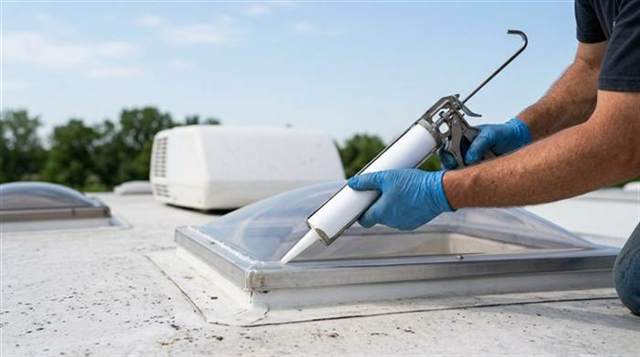
Buying the wrong cleaner or caulk can ruin your camper roof. So check which of the three flexible white sheets you have in two minutes! Unscrew the plastic trim ring inside a ceiling roof vent to peek at the cut underside edge of the roof sheet. Black underneath means EPDM rubber, matching white/tan with slight grain means TPO, and slick smooth bright-white vinyl means PVC.
01 • Reference ChartQuick Reference Chart
| Clue to Check | EPDM (Classic Rubber) | TPO vs PVC (Modern Sheets) |
|---|---|---|
| Color of the underside edge | Pitch black (like a bike tire tube) | TPO & PVC are white, tan, or gray on BOTH sides |
| Rub a wet finger across older top | Leaves milky white chalky dust | TPO rarely chalks. PVC never chalks at all |
| Surface texture & shine | Dull flat matte rubber feel | TPO feels lightly pebbled/waxy. PVC feels slick & smooth |
| Typical camper model years | Very common pre-2016 rigs | Most 2016+ towables use TPO, Alpha, or PVC |
| Underside fabric threads visible? | No — solid black rubber | PVC often shows tiny crisscrossing fabric threads underneath |
| Standard flat seam caulk | Dicor Self-Leveling Lap Sealant | Dicor Self-Leveling or Alpha 1021 (check PVC label) |
Key Rules Before You Start
The 2-Minute Ceiling Vent Peek Trick
From standing on a ladder outside, almost every flexible camper roof looks identical: a flat sheet of off-white or tan material stretched from gutter to gutter. Why guess from the top when the easiest giveaway hides right inside your bathroom or bedroom ceiling fan.
Read deeper field notes
Grab a Phillips screwdriver and step inside. Unscrew the four to eight little screws holding up the square plastic trim collar inside your ceiling vent and slide that plastic ring straight down.
Look up along the raw cut edge of the wood hole where the roof sheet folds slightly under the vent frame — you can now see both the top and bottom of your roof sheet!
Spotting EPDM Rubber right away by Its Black Back
If the top of your roof is white. Still, the hidden underside edge is jet-black like an old bicycle inner tube, stop searching right now — you own a classic EPDM rubber roof!
Read deeper field notes
Roof makers sandwich white sun-reflecting rubber over tough black rubber so summer sunlight does not bake your bedroom. As EPDM rubber ages in the sun, the white top layer slowly sheds tiny specs of white dust — that is what causes annoying gray "black streaks" running down your camper walls every time it rains.
Never scrub EPDM harshly with rough pads. Shedding light chalk is normal until black rubber starts peeking through.
Telling TPO Apart From PVC When Both Sides Are White
If both the top AND the underside cut edge are white, ivory, or light gray, you have either TPO (including Alpha Super Flex) or PVC. Next, check inside your camper kitchen and bathroom cabinet doors for a factory roof care sticker — brands love bragging loudly whenever they upgrade a trailer to PVC!
Read deeper field notes
Still no sticker. Feel a clean spot on top and peek closely at that cut edge again.
TPO feels slightly stiffer with a tiny pebble or orange-peel grain, almost like a flexible plastic binder. PVC feels noticeably smoother and slicker — like a heavy swimming pool liner — and often has tiny woven fabric threads pressed into its underside.
Never call every white camper roof a "rubber roof" at the parts counter and buy random roof AC unit! Spraying UV rubber-roof AC unit meant for old EPDM onto a modern TPO or PVC sheet can leave a slimy dirt-magnet film — or worse, people grab harsh vinyl cleaners that dry out real EPDM rubber until it shrinks away from the corner trim.
Clean & Seal Step-by-Step Checklist
Follow these steps on a dry afternoon so your patch seals tight the first time:
- Check inside kitchen and bathroom cabinet doors first for a factory roof care sticker.
- If no sticker exists, unscrew the interior plastic trim ring inside a bathroom or hallway ceiling vent.
- Look at the cut underside of the roof sheet. Black underside equals EPDM rubber every time.
- If white or tan on both sides, feel the top grain and look for woven backing threads to separate TPO from PVC.
- Snap a phone photo of the cut edge and write your roof type inside your owner binder for future shopping.
Common Questions
Which RV roof lasts longest. EPDM, TPO, or PVC?
PVC usually wins for lifespan and easy care — staying bright white without chalky streaks for fifteen to twenty-plus years — followed closely by modern TPO and EPDM rubber at twelve to twenty years, provided you keep your vent caulk sealed tight!
Is Dawn dish soap safe on all three roof types while I figure out mine?
Yes, it is 100% safe on every single one! A five-gallon bucket of warm water mixed with a small squirt of blue Dawn dish soap and a soft bristle brush safely washes EPDM rubber, TPO, and PVC alike without hurting your roof or voiding warranties.
What if my roof is hard and knocks like a boat hull when tapped?
Then your camper does not have EPDM, TPO, or PVC at all — you have a solid one-piece molded fiberglass roof (or sheet aluminum)! Hard roofs never tear on tree twigs. Still, you still must inspect and reseal every skylight and vent.
Related Guides

Roof Types by Major RV Brand
Most modern towable campers built since 2018 by Grand Design, Jayco, and Forest River do NOT have old-school…

Safe Cleaners for RV Rubber & TPO Roofs
Plain blue Dawn dish soap mixed into a bucket of warm water is the safest, cheapest cleaner for every flexible RV…

Brinkley Model I
Bumper-pull camper shoppers begged for years to get high-end fifth-wheel build quality in a mid-sized travel…

Outdoors RV
Built in eastern Oregon for boondockers who treat eighty-gallon water tanks and washboard logging roads as…