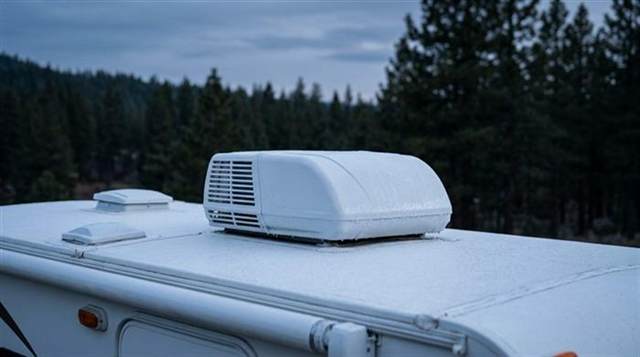
Your camper's rooftop AC only uses around 1,400 watts while running—so why does it choke and stall a quiet 2,200-watt portable generator the instant it kicks on. For the first half-second, the cooling motor gulps a giant 3,500+ watt startup jolt! Wiring a 4-wire Micro-Air EasyStart soft-starter inside the roof cover ramps the motor up smoothly, slashing that startup gulp by up to 75%.
01 • Reference ChartQuick Reference Chart
| EasyStart Wire Color | Where It Connects Inside Rooftop AC | Job |
|---|---|---|
| Black Wire | Splices into the main Cooling Pump power wire (Common "C") | Watches and powers the main AC cooling motor when it turns on |
| White Wire | Plugs onto a free prong on the "C" group of the silver tin-can helper (capacitor) | Shares the neutral return path on the silver metal cylinder |
| Brown Wire | Connects ONLY to the cut cooling pump "Run" (R) wire going to the motor | Lets the EasyStart gently ramp up the motor instead of slamming it on |
| Orange Wire | Plugs onto the "HERM" (or "H") prong group on top of the silver cylinder | Controls the startup helper winding during the first split-second |
| Old Hard-Start Tube (If Present) | MUST REMOVE black plastic cylinder & extra wire from HERM! | Factory boost cylinders fight against soft-starters—unplug and toss aside |
| 5 Learning Starts on Big Power | Run AC 5 times (with 5-minute rests between) on campground plug | Teaches the EasyStart box your exact AC motor's startup rhythm |
Key Rules Before You Start
Why Starting an AC Is Like Pushing a Heavy Shopping Cart
Picture shoving a grocery cart stacked with four cases of water across a parking lot. Getting that heavy cart moving from a dead stop takes a huge shove with both legs—yet once the wheels are rolling, you can push it easily with two fingers!
Read deeper field notes
Your camper's rooftop AC unit cooling pump (called the compressor) behaves the exact same way every time your thermostat clicks Cool. Once spinning smoothly, a typical 13,500 or 15,000 BTU camper AC sips roughly 12 to 14 amps (about 1,500 watts).
However, for the first blink of an eye from a dead stop, the motor slams on all at once and gulps 50 to 60 amps! That violent split-second gulp trips your driveway 15-amp garage outlet or bogs a quiet 2,200-watt suitcase generator right into overload shutdown.
How Four Colored Wires Tame That Giant Startup Gulp
Up on your camper roof underneath the plastic AC hood sits a rain-tight box called the Micro-Air EasyStart once you mount it—alongside a shiny silver soda-can-shaped part called the run capacitor. The AC's factory power storage helper.
Read deeper field notes
Instead of replacing your AC unit, the EasyStart splices four color-coded wires—Black, White, Brown, and Orange—right around that silver cylinder and the three wires running to the cooling pump. Think of a regular AC switch like dropping the clutch and flooring the gas pedal.
Meanwhile, the EasyStart acts like easing onto a freeway on-ramp over half a second. Important rule while you are up on the roof.
If your AC already had an extra black plastic tube clipped beside the silver can (an old "hard-start capacitor"), unplug and remove that extra black tube completely so it does not fight the EasyStart!
Do Not Skip the 5-Start "Practice Run" Before Trying Your Generator
Right after wiring a new EasyStart, lots of excited owners right away fire up their small portable generator to test it—and wonder why the generator stumbles on the first try! Inside the EasyStart lives a smart trainer that must practice starting your exact AC unit five times.
Read deeper field notes
Meanwhile, plugged into strong, steady campground or household power before it knows how gently to ramp up. Plug your camper into solid campground power, set the indoor thermostat to Cool so the rooftop cooling pump kicks on, let it blow cold air for two minutes, and then turn Cool OFF and wait five full minutes so gas pressure settles inside the pipes.
Repeat that start-and-rest routine five times total. By start number five, the EasyStart is ready for your small generator!
Two critical wiring safety rules apply to rooftop AC soft-starters! First, internal rooftop AC wiring involves 120-volt line power, roof fall hazards, and high-voltage run capacitors that store a lethal electric charge even after campground power, generators, and inverters are disconnected. If you are not trained and equipped to safely isolate all power sources, discharge HVAC capacitors, and verify zero voltage, have a certified RV tech install the soft-starter. Second, never run a rooftop RV AC unit through a standard household extension cord, which can overheat, melt plugs, and cause an electrical fire!
Step-by-Step Safety & Setup Checklist
Check each step below in order before turning power or water back on:
- Verify your exact rooftop AC brand and model diagram from Micro-Air, and consider hiring a certified RV tech so you do not face rooftop fall hazards or high-voltage capacitor shock risks.
- Before any RV tech opens a rooftop AC electrical box, ALL power sources must be isolated. Campground power unplugged, generator off, inverter off, and main breakers off, and the HVAC run capacitor must be properly discharged and verified at zero volts.
- Per Micro-Air design instructions, any secondary factory "hard-start" start capacitor and starter relay connected to the HERM terminal is removed when wiring the 4-wire soft-starter harness.
- Once installed and closed up by a qualified installer, plug the RV directly into a properly rated 30-amp or 50-amp campground power outlet.
- Complete the 5 Cool learning start cycles (waiting at least 5 full minutes with the compressor off between each cycle) on dedicated campground power before operating on an inverter generator.
Common Questions
Can one Honda EU2200i, or similar 2,200-watt generator. Really run a 13,500 BTU camper AC?
In many conditions, yes—once an EasyStart completes its 5 learning starts on campground power, a properly rated 2,200-watt inverter generator can often start and run a single 13,500 BTU rooftop AC at moderate altitudes and temps if Eco-Throttle is turned OFF and all other 120-volt appliances. Water heater, microwave, converter high load. Are switched off.
Is it safe to run my camper AC on a regular 15-amp household extension cord with an EasyStart?
Avoid running a rooftop RV AC unit through a standard household extension cord! Even with a soft-starter reducing the brief startup spike, a rooftop AC pulls a continuous 12 to 15+ amps for hours on hot afternoons. This causes voltage drop, overheats household 15-amp plugs and extension cords, and creates a serious melting and fire hazard.
Do I have to repeat the 5 learning starts every time I unplug my camper?
No, you only do the 5-start training once! As soon as your EasyStart finishes those first five practice starts, it saves your AC unit's exact startup rhythm permanently inside its memory—even when your camper sits completely unplugged in winter storage for months.
Related Guides
WFCO Converter Lithium Mode Fix
Your converter (the camper's built-in battery charger hidden behind the indoor fuse box) turns campground plug…
Dometic Brisk Air II Sensor Placement
Inside your Dometic Brisk Air II ceiling cover hangs a temperature sensor (a tiny clip-on temperature wire that…
Norcold RV Fridge Error Code F
First: If you smell propane or sharp ammonia, hear hissing, or have a sounding propane/CO alarm, evacuate everyone…
Furrion Error Code E5
First: If your Furrion tankless water heater shows E5 and you smell propane, hear hissing, or have a propane/CO…