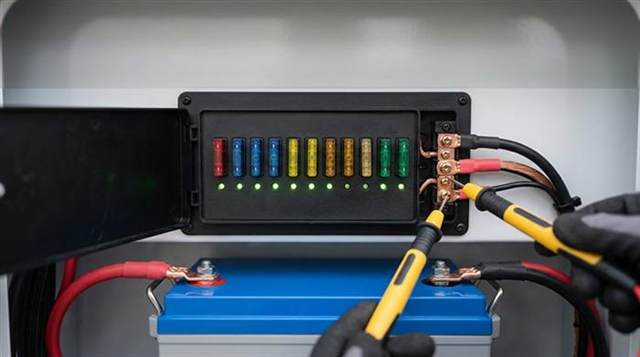
Your converter (the camper's built-in battery charger hidden behind the indoor fuse box) turns campground plug power into 12-volt battery power. Newer WFCO Auto-Detect chargers promise to spot lithium batteries on their own. Still, thin camper wires often trick the charger into staying on regular battery mode at 13.6 volts. That leaves lithium batteries stuck around 80% full unless you wake it up or add WFCO's tiny jumper wire.
01 • Reference ChartQuick Reference Chart
| WFCO Charger Label | How It Picks Battery Type | What You Do for 100% Lithium Charge |
|---|---|---|
| WF-8955-AD / WF-8735-AD (Auto-Detect) | Tries to sense battery type on its own | Drain battery to 20% once, or ask WFCO for their lock-in jumper wire |
| WF-8955LIS (Manual Switch Model) | Tiny two-way slide switch on the charger | Slide the little switch from Lead-Acid over to the lithium spot |
| Back-Panel WAGO Clip Models | Two orange lever clips on the back wires | Snap the short factory jumper wire across both orange lever clips |
| Older WF-8955PEC / MBA (Pre-2020) | Built only for regular lead-acid batteries | Stays at 13.6 volts (80% full) until you swap the inner charger board |
| Green LED Light Inside Fuse Panel | Shows regular 13.6-volt charging mode | Means the charger has NOT switched into 14.6-volt lithium mode yet |
| Blue or Amber Lithium LED Light | Shows 14.6-volt full lithium charging mode | Leave it alone—your lithium battery is getting a full 100% charge |
Key Rules Before You Start
Why Your Built-In Battery Charger Stops Around 80%
Behind the plastic indoor door with your fuses and house switches sits the converter. The camper's built-in battery charger.
Read deeper field notes
6 volts all day. 5-volt push to reach 100%.
6 volts, your expensive lithium battery simply stops filling right around 80%. Why does WFCO's "Auto-Detect" brain guess wrong so often (most campers use long, skinny wires running from the indoor fuse box out to the front tongue battery box) by the time power travels down that long wire, it loses a tiny bit of push.
The WFCO charger misreads that weak signal, assumes an old-fashioned lead-acid battery is hooked up, and refuses to kick up into full lithium speed.
How the Tiny Jumper Wire Locks In Lithium Mode
A jumper wire is just a finger-length piece of coated copper wire that connects two pins together like a tiny shortcut bridge. 6 volts forever.
Read deeper field notes
If the clips are left empty, the charger stays in regular battery mode. What if your fuse panel says "Auto-Detect" with "-AD" in the model number and has no obvious switch on the front.
Call WFCO support with your serial number before buying a whole new charger. 6-volt lithium mode every single trip.
The Free Driveway Trick If You Do Not Have a Jumper Yet
If you are already at a campsite without a jumper wire, you can often force a stubborn WFCO Auto-Detect charger to wake up on your own. Unplug the camper's outside power cord and turn off any rooftop solar switches so nothing is feeding the battery.
Read deeper field notes
Turn on indoor lights and fans until your battery screen drops down to roughly 15% or 20% full, without letting it hit zero. Once the lithium battery is truly hungry at 20%, plug your camper back into the campground power post.
Because the battery gulps a huge rush of power for over fifteen straight minutes, the WFCO charger finally recognizes the lithium pattern and flips its tiny indicator light to lithium mode. Keep in mind that quick weekend top-offs from 70% usually will not trigger this wake-up trick.
Never open or poke around behind your camper's power center while ANY power source is still active! Even after unplugging the outside shore cord, your 12-volt battery bank, rooftop solar controller, onboard generator, or inverter can still feed live power into the panel, and internal converter capacitors store hazardous charge. Isolate all AC and DC power sources. Shore, generator, inverter, solar, and battery negative, and verify zero voltage with a meter—or have a qualified RV tech install internal board jumpers.
Step-by-Step Safety & Setup Checklist
Check each step below in order before turning power or water back on:
- Open your indoor fuse panel door and check the sticker for "-AD" (Auto-Detect) or "-LIS" (manual switch) in the WFCO model number.
- Before accessing any converter switch or terminal, isolate ALL power sources: unplug campground power, shut off generator and inverter, disconnect rooftop solar, and unhook the negative (-) battery cable.
- Check your exact WFCO model manual to see whether your unit uses an external user-easy-to-reach LA/LI selector switch or requires a WFCO-authorized jumper/board update.
- Have a qualified RV tech install any internal circuit-board jumper, or follow WFCO’s model-specific instructions after confirming zero AC and DC voltage with a multimeter.
- Once reassembled with all covers secured, reconnect battery and campground power and check voltage at the battery posts with a digital multimeter. ~14.4V to 14.6V in lithium full-charge mode.
Common Questions
Will it hurt my lithium battery if my WFCO charger stays stuck at 80%?
No, stopping at 80% will never damage a lithium camper battery! Unlike old lead-acid batteries that get ruined when left partly full, lithium batteries actually love hanging out at 80%. You only lose the top 20% of your unplug-and-camp runtime until you top it off properly.
Can I leave the lithium jumper wire installed if I switch back to a regular battery later?
No! You must pull the lithium jumper wire right back out before hooking up a regular lead-acid or AGM battery, leaving a regular wet battery locked at 14.6 volts non-stop will boil out the liquid inside, make a rotten-egg smell, and ruin the battery.
Why do I see 14.5 volts at the indoor fuse panel but only 13.7 volts at my battery?
Thin factory camper wires lose pushing power over ten or fifteen feet, much like water losing pressure through a skinny garden hose. Tightening loose wire screws or upgrading to thicker battery cables lets the full 14.5 volts actually reach your battery posts.
Related Guides
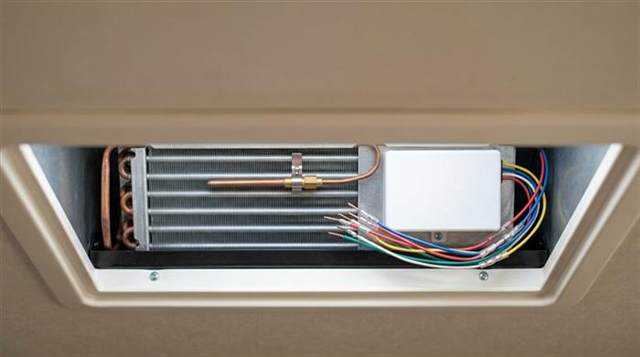
Dometic Brisk Air II Sensor Placement
Inside your Dometic Brisk Air II ceiling cover hangs a temperature sensor (a tiny clip-on temperature wire that…
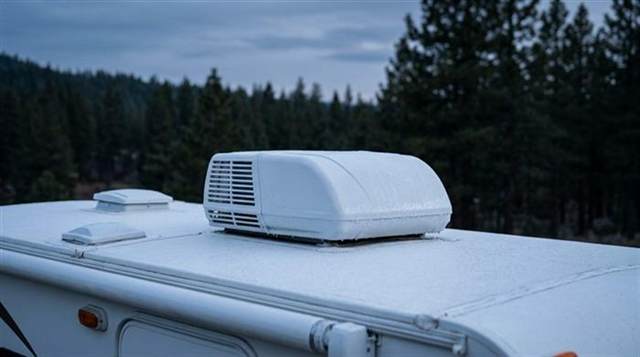
Why Your RV Air Conditioner Freezes Up
When weak airflow comes out of your camper ceiling vents and water starts dripping on the floor, your rooftop AC…
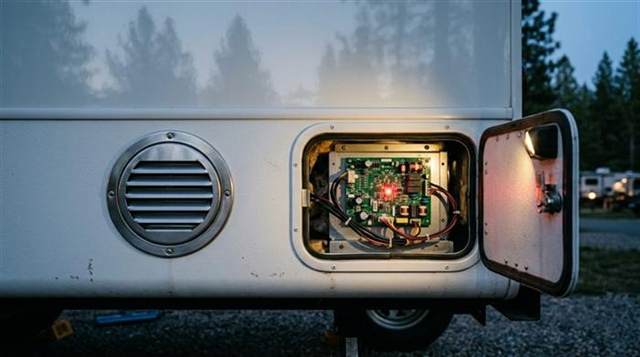
Suburban RV Furnace 3 Blinks
First: If you smell propane, hear hissing, have an active propane or CO alarm, or anyone feels dizzy, headachy, or…
Lippert Under-Floor Rack & Pinion Slide Stuck
If your Lippert electric through-frame rack-and-pinion slide stops moving, keep everyone completely clear of the…