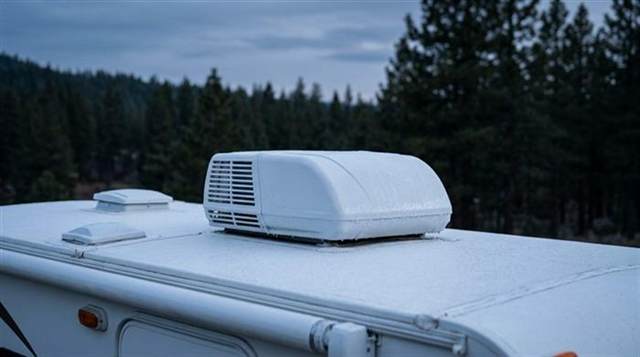
Hear a loud two-second wiring buzz from the roof followed by a metallic "click" while your cabin lights dim. Switch your wall thermostat from COOL to OFF (or FAN ONLY) right now! Your AC motor is stalling on startup and tripping its heat switch. Low park voltage, fast dial clicks, or a bad start part usually cause this. Check your indoor line voltage and shed other 120V loads. Leave all rooftop shroud and capacitor work to a qualified RV tech.
01 • Fault Specs & Root CauseFault Summary
| What to Know | Details |
|---|---|
| Screen Code / Blink Pattern | LR / HUM |
| Appliance Maker | Coleman-Mach / Dometic / GE |
| Camper System | AC & Climate |
| How Urgent Is It? | Shut Off COOL Mode Immediately |
| Basic Tools Needed | Plug-in interior AC outlet voltage monitor or surge protector display readout |
What Is Happening Inside the Unit
An RV rooftop AC unit compressor draws 12 to 15 amps while running. However, requires a brief startup surge several times higher to start against under pressure refrigerant.
Read deeper field notes
When a busy campground’s wiring grid sags below 108 volts AC on a hot afternoon—or when long extension cords and overloaded 30-amp circuits drop voltage—the compressor motor cannot turn over, hums loudly, overheats, and trips its overheat safety switch. Even when campground voltage is strong at 120V.
That turns the AC off and right away back on before internal refrigerant pressures equalize, which takes at least 3 to 5 minutes will stall the compressor. If voltage is healthy and the unit rested 5+ minutes yet still hums and clicks off, an internal rooftop start or run capacitor or compressor winding has likely failed and requires professional service.
Step-by-Step Fix
Switch COOL Mode OFF right away to Prevent Compressor Burnout
Every time a stalled compressor hums and trips its overheat safety switch, the sealed motor windings overheat severely. Turn your thermostat from COOL to OFF (or FAN ONLY) right away so the compressor stops attempting to start.
Check Campground Line Voltage Inside Your RV
Look at your wiring Management System (surge protector) voltage readout or plug a simple digital AC voltage monitor into an indoor wall outlet. If campground voltage drops below ~108 volts AC under load, do not attempt to run the AC unit—low-voltage brownouts destroy compressor motors.
Turn Off Other Heavy 120V Appliances on Your 30-Amp Service
On a 30-amp RV cord, running an electric water heater element, microwave, coffee maker, or electric fireplace at the same time as the rooftop AC overloads the circuit and increases voltage drop. Switch your water heater and gas-and-electric RV fridge to propane. After checking for normal propane operation, and remove any unnecessary extension cords.
Wait at Least 5 Full Minutes Before One Test Restart
High-side and low-side refrigerant pressures inside the AC take at least 3 to 5 minutes to equalize after shutdown, and the overheat safety switch needs several minutes to cool and reset (once indoor line voltage reads strong (112V–124V AC) with other heavy loads off, test COOL mode once). If it hums and clicks off again, turn COOL off right away.
Schedule a Qualified RV tech for Rooftop Capacitor or Soft-Start Service
If your AC still hums and trips off after a 5-minute rest on healthy 120V power, do NOT climb onto the roof to open the AC electrical box or short capacitor terminals with a screwdriver! Rooftop AC capacitors store lethal high-voltage wiring charges even after campground power is unplugged (also, flipping one breaker does not necessarily isolate shore, generator, inverter, and 12V supplies) have a qualified RV tech test and replace the start/run capacitors.
Never leave a humming AC unit switched to COOL hoping it will eventually start on its own. Never run an RV AC unit during a campground low-voltage brownout or through a light-duty household extension cord. NEVER open the rooftop AC electrical box or attempt to discharge start/run capacitors with a screwdriver yourself. High-voltage stored charge and wet/sloped RV roofs create severe deadly shock and fall hazards.
Stop & Call a Repair Tech When: Call a qualified RV service tech whenever the rooftop compressor continues humming and clicking off despite a 5-minute rest and steady 115V–120V campground power, or if you want a maker-compatible soft-start module or new start/run capacitor professionally installed.
Spare Parts to Carry
- Plug-in digital AC outlet voltage monitor to check campground voltage from inside the RV
- 30-amp or 50-amp RV wiring Management System (surge protector) with automatic low-voltage shutoff
- Spare washable indoor foam return-air filter pads
Common Questions
Why is DIY rooftop AC capacitor discharging or new dangerous?
Motor start and run capacitors inside the rooftop AC unit can retain high voltage even after you unplug the RV shore cord or flip an indoor breaker—and RVs equipped with generators, inverters, and 12V control wiring can have multiple active power paths. Combined with working atop an elevated RV roof, internal AC wiring service belongs strictly with a trained RV tech.
Why does my surge protector surge protector shut off power to the whole RV when the AC tries to start?
When compressor startup current pulls a weak campground power post below the surge protector low-voltage threshold (usually around 104 volts AC), the surge protector disconnects power to protect your rooftop AC compressor and appliance circuit boards from brownout overheating.
Why must I wait 3 to 5 minutes after turning the AC off before turning COOL back on?
While running, the compressor pumps refrigerant to high pressure on one side of the system. If you switch COOL off and right back on within seconds, the motor tries to start against trapped high pressure, stalls with a loud hum, and trips its overheat safety switch.
Related Guides
Coleman-Mach RV AC Freezing Up
If your Coleman-Mach rooftop AC roars loudly on a humid day yet barely pushes cool air out the ceiling vents—or…
Furrion RV Thermostat Error Code E3
Error Code E3 on a Furrion RV wall thermostat indicates an indoor cooling fin temperature sensor fault.
3-Valve RV Water Heater Bypass Chart
Hidden behind an indoor wood cabinet panel on the back of your 6-gallon hot water tank sit three plastic or brass…
Unwritten Campground Etiquette Rules
Campground walls are made of canvas and thin plywood.