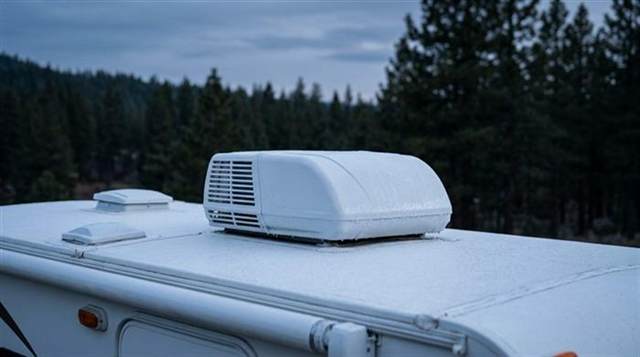
If your Coleman-Mach rooftop AC roars loudly on a humid day yet barely pushes cool air out the ceiling vents—or starts dripping cold water inside—the indoor cooling fins has iced over. Switch your wall thermostat from COOL to FAN ON HIGH right away (compressor off) and place towels underneath the ceiling grille. Meanwhile, warm cabin air melts the ice block. Clean the removable foam return-air filters, and have a qualified RV tech inspect the freeze sensor or internal ceiling air box if icing continues.
01 • Fault Specs & Root CauseFault Summary
| What to Know | Details |
|---|---|
| Screen Code / Blink Pattern | ICE BLOCK |
| Appliance Maker | Coleman-Mach |
| Camper System | AC & Climate |
| How Urgent Is It? | Safe to Sleep — Thaw With Fan Only |
| Basic Tools Needed | Towels or shallow pan for meltwater, warm dishwater for removable foam filters |
What Is Happening Inside the Unit
Rooftop RV AC units absorb cabin heat across aluminum indoor cooling fins. When indoor airflow is restricted by dusty return-air foam filters—or when the fan runs on LOW during high coastal humidity—moisture condensing on the fins drops below 32°F and freezes into solid ice that blocks airflow.
Read deeper field notes
If your filters are clean and the unit still freezes up, the internal freeze-control sensor (temperature sensor) may be displaced or faulty, air may be short-cycling across the internal ceiling air box divider, or the sealed refrigerant system may have developed a low-charge leak requiring professional service.
Step-by-Step Fix
Switch Thermostat From COOL to FAN HIGH ON (Compressor Off)
Running COOL mode after ice blocks the indoor cooling fins provides zero cooling and stresses the compressor. Switch COOL off and run continuous FAN HIGH ON so room-heat cabin air circulates across the coil and melts the ice safely.
Place Towels and a Catch Pan Beneath the Ceiling Grille
A heavily iced indoor cooling fins can shed meltwater faster than the rooftop drain pan weeps it outside, especially if the RV is parked slightly off-level. Lay thick towels and a pan under the indoor ceiling assembly until thawing completes.
Wash and Dry the Removable Return-Air Foam Filters
Unclip the plastic return-air filter vents on the indoor ceiling shroud and remove the foam filter pads. Rinse away dust and lint in warm soapy sink water, press dry in a towel, and let them dry before snapping the filter grilles back in place.
Use HIGH Fan Speed and Follow Operating Manual Louver Guidance in High Humidity
Once thawed and dry, operate the AC on HIGH continuous fan rather than LOW or AUTO during muggy weather, and check your Airxcel/Coleman-Mach operator manual regarding center quick-cool dump louvers on ducted ceiling air boxes. Dumping cold discharge air right next to the return intake can cause cold air short-cycling and freeze-ups.
Have a trained RV tech Inspect Internal ceiling air box Dividers & Freeze Sensors
Do not open internal wiring control boxes or guess mounting-bolt torque yourself—flipping a single 120V breaker does not necessarily isolate all 120V/12V/inverter/generator supplies (also, rooftop gasket bolt torque limits vary by exact model) if icing or dripping continues with clean filters, have a qualified RV tech service the freeze temperature sensor, ceiling air box baffle, and roof gasket.
Never chip ice off indoor cooling fins with a screwdriver, knife, or heat gun—one nick in the thin refrigerant tubing ruins the sealed system permanently. Also never remove internal wiring covers without full power isolation (also. Never arbitrarily crank the four ceiling mounting bolts without the exact maker torque limit) over-tightening crushes the roof gasket and causes leaks.
Stop & Call a Repair Tech When: Call a qualified RV tech if the AC continues to freeze up with clean return filters and HIGH fan speed, if only part of the coil frosts. Indicating a sealed-system refrigerant issue, or if the internal ceiling air box divider, freeze temperature sensor, or rooftop mounting gasket needs service.
Spare Parts to Carry
- Spare pair of clean factory new foam return-air filter pads
- Printed copy of your Airxcel / Coleman-Mach ceiling air box owner’s manual
- Absorbent microfiber towels for catching condensation during a coil thaw
Common Questions
Why should I use FAN HIGH instead of AUTO LOW during humid summer nights?
LOW fan speed lets humid air linger on cold indoor cooling fins too long, dropping fin temps below 32°F. Meanwhile, AUTO cycles airflow off right as frost crystals form. Running HIGH fan speed keeps warm cabin air moving across the coil.
Does opening the center "dump valve" louvers on a ducted ceiling assembly contribute to freeze-ups?
On many ducted ceiling air boxes, dumping cold supply air straight downward right next to the return-air intake grille lets frigid air get pulled right away back into the indoor cooling fin intake, chilling the coil below freezing. Meanwhile, the rest of the RV stays warm.
Should I tighten the four ceiling mounting bolts every year if water drips inside?
Do not apply a generic "snug" rule to rooftop AC mounting bolts. Bolt torque limits and gasket compression limits vary by exact AC maker and model, and too much torque can crush the foam gasket or crack the drain pan. Have a qualified RV tech check the roof drain channels, ceiling air box seal, and exact factory bolt torque with power isolated.
Related Guides
RV AC Compressor Humming & Clicking Off on 30-Amp
Hear a loud two-second wiring buzz from the roof followed by a metallic "click" while your cabin lights dim.
Furrion RV Thermostat Error Code E3
Error Code E3 on a Furrion RV wall thermostat indicates an indoor cooling fin temperature sensor fault.
7-Pin RV Trailer Plug Wire Colors
If you replace a crushed 7-pin trailer plug on your camper using a standard utility-trailer color chart from the…
Stopping Winter RV Condensation & Mold
CRITICAL SAFETY WARNING.