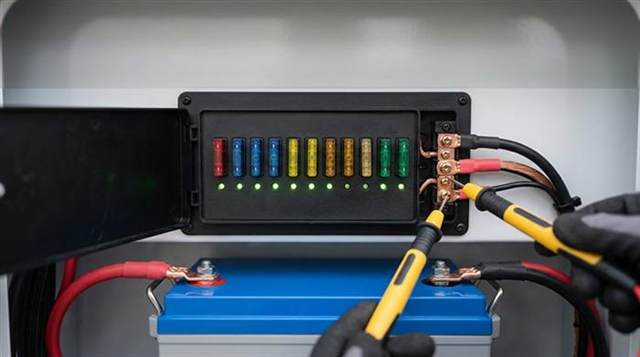
Your 120V outlets work on campground power, yet your 12V cabin lights are dimming and your house battery is not charging. First, check that your RV’s main 12V Battery Disconnect switch is turned ON. Next, flip the dedicated CONV (Converter) 120V circuit breaker completely OFF and back ON. Disconnect all power sources before inspecting the 12V reverse-polarity blade fuses on the front panel. Match any replacement fuse to the exact amp rating printed on your WFCO panel label. Leave live voltage probing and internal board work to a qualified RV tech.
01 • Fault Specs & Root CauseFault Summary
| What to Know | Details |
|---|---|
| Screen Code / Blink Pattern | NO CHARGE |
| Appliance Maker | WFCO / Progressive Dynamics |
| Camper System | 12V & Shore Power |
| How Urgent Is It? | Safe to Sleep — Fix Tomorrow |
| Basic Tools Needed | Flashlight and spare car-style ATC blade fuses matching your exact WFCO panel label |
What Is Happening Inside the Unit
Your RV’s lights, water pump, vent fans, and appliance control boards run on 12-volt DC power. Your WFCO power center converts 120V AC shore power into 12V DC to run cabin loads and recharge your house battery.
Read deeper field notes
The battery stops charging whenever the converter 120V breaker trips, the battery disconnect switch is turned off, or the reverse-polarity DC fuses blow. Charging behavior also depends on your exact converter model and battery chemistry.
Standard WF-8900 lead-acid units charge differently than WF-8900-AD Auto-Detect or lithium-switchable models.
Step-by-Step Fix
Verify Your RV’s Main 12V Battery Disconnect Switch Is ON
Check your entry stairwell, battery box, or front pass-through storage bay for the main 12V Battery Disconnect switch. When set to OFF while plugged into campground power, the converter still powers interior 12V lights directly. However, your house battery is completely isolated and will not charge!
Reset the Dedicated "CONV" 120V Circuit Breaker
Open the front door of your indoor distribution panel and find the 120V AC breaker labeled CONV or CONVERTER. Flip the breaker handle all the way to the OFF position until it clicks. Then flip it firmly back to ON.
Isolate All Power Sources Before Visually Inspecting Front Panel Fuses
Do NOT stick multimeter probes onto live internal lugs or open the power center housing—an RV power center can be powered on at the same time by 120V campground power, an onboard generator, an inverter, solar controllers, and the 12V battery bank! Turn off and unplug campground power, and turn off generator/inverter/solar and battery disconnect before pulling the labeled backwards-wire blade fuses on the front 12V fuse block to inspect for a broken metal link.
Use Only the Exact Factory Fuse Rating Printed on Your WFCO Panel Label
Backwards-wire fuse ratings vary by exact WFCO converter amp rating model. For example, 35A, 45A, 55A, 65A, or 75A models use different factory fuse ratings per the WF-8900 series manual. Never install a generic 30A or 40A fuse by guesswork—replace a blown fuse only with the exact fuse type and amp rating printed on the label inside your power center door.
Confirm Model-Specific Battery Chemistry Settings With Your Manual
If your converter powers on but undercharges a lithium (lithium) or AGM battery bank, check the exact model number and revision on your WFCO panel sticker against the official WFCO manual. Never install homemade wire jumpers inside a power center. Have a qualified RV tech service internal converter modules or charging wiring.
Never remove the inner dead-front trim cover of a distribution panel or probe internal converter lugs. Meanwhile, powered on. Multiple AC and DC power sources can stay live even after flipping one breaker. Never replace a backwards-wire fuse with an untested amp rating. Never install homemade wire jumpers to force bulk voltage. Never clamp an unregulated car-style boost charger onto connected RV battery cables.
Stop & Call a Repair Tech When: Call a qualified RV tech or electrician if the converter breaker and front-panel backwards-wire fuses are intact and the battery disconnect is ON yet the battery does not charge, if backwards-wire fuses blow again right away, or if you need an internal converter main board replaced or upgraded for lithium batteries.
- WFCO WF-8900 Power Center Series Operator Manual (factory PDF) ↗
- WFCO Auto-Detect WF-8900-AD Series Manual (factory PDF) ↗
- Propane Education & Research Council (PERC): Important Propane Safety Information ↗
- U.S. CPSC Carbon Monoxide Safety Fact Sheet ↗
- ESFI Electrical Safety Foundation: Water-Damaged & Appliance Safety ↗
Spare Parts to Carry
- Spare car-style blade fuses matching the exact factory ratings printed inside your WFCO panel door
- Printed copy of your exact WFCO or Progressive Dynamics power center manual
- Flashlight for reading the distribution panel fuse label clearly
Common Questions
Why is my WFCO converter cooling fan turning on and off at night?
Per WFCO’s operator manual, the cooling fan inside WF-8900 series power centers is load-controlled. It turns on its own as 12V DC current draw increases (such as when cabin lights, furnace blowers, or battery charging draw current), and shuts off when load tapers down.
Why shouldn’t I open the power center after waiting a few minutes to probe the converter lugs or swap the board myself?
An RV distribution panel connects high-voltage 120V AC branch circuits alongside high-current 12V DC battery, solar, and inverter feeds. Turning off or unplugging a single source does not guarantee all terminals inside the cabinet are de-powered on. Leave internal testing and converter cartridge new to a qualified RV tech.
What fuse size goes into the Reverse wire direction slots on a WFCO converter?
There is no single universal fuse size—the required fuse rating depends on your exact WFCO model number (such as WF-8935, WF-8945, WF-8955, WF-8965, or WF-8975). Always read the fuse chart printed directly on your WFCO panel door and in the WF-8900 Series manual. Never substitute a different rating.
Related Guides
RV GFCI Outlet Keeps Tripping in the Rain
If an RV GFCI outlet trips during rain, treat it as an active electric shock warning.

RV Propane & Carbon Monoxide Detector Beeping at
Woken up by a beeping RV propane or carbon monoxide (CO) detector?
2-Valve RV Water Heater Bypass Chart
Opened up the access panel behind your camper's 6-gallon hot water tank expecting three valves and only spotted…

Your Dealership Delivery Walkthrough Plan
Why a thorough, safe Pre-Delivery checkup (PDI) with a trained RV tech beats waiting weeks for a warranty service…