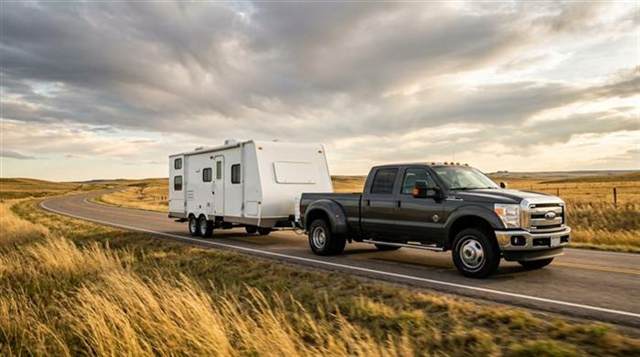
You are towing across an open highway when gusting crosswinds and the air wake from a passing eighteen-wheeler push against your travel trailer. This causes the trailer tail to begin yawing side-to-side behind your tow vehicle.
01 • Field BreakdownHow It Happens & How to Prevent It
Active Highway Sway. Why You Must Follow Your Exact Tow-Vehicle & Controller Manual
If your trailer begins swaying on the highway, two universal rules come first. Hold the steering wheel steady to keep your lane without jerking the wheel back and forth, and ease your foot smoothly off the accelerator pedal to reduce speed gradually.
Read deeper field notes
Never slam on the tow-vehicle brake pedal or try to speed up out of sway! However, when it comes to touching the manual trailer-brake override lever/paddle on your dashboard, never follow a blanket internet rule or believe any "straightens the rig in two seconds" guarantee.
Published maker instructions differ depending on your exact equipment! Especially, the exact 2026 Ford F-150 Owner’s Manual instructs that its integrated trailer brake controller manual lever is used for setting brake gain and clearly warns that applying the trailer brake controller manual lever during trailer sway may push off course the rig!
By contrast, some add-on brake-controller manuals and generic towing guides describe applying manual trailer braking when equipped. Always read and follow the exact owner’s manual for your specific tow vehicle and brake controller before towing—and never disable your truck’s digital trailer sway control system on wet, snowy, or icy roads unless your exact vehicle owner’s manual especially instructs you to do so for a narrow condition.
Tongue Weight Balance & Checking All Ratings Before Adding Water as Ballast
Proper cargo loading is your primary defense against trailer sway. Conventional travel trailers must be loaded within the exact tongue-weight percentage range specified by the tow-vehicle, hitch, and trailer maker manuals.
Read deeper field notes
Commonly 10% to 15% of loaded trailer weight. Meanwhile, never exceeding the hitch receiver or rear axle rating.
Loading heavy cargo—such as generators or heavy racks—on a rear bumper behind the rear axles removes weight from the hitch ball and dramatically increases sway risk. Some campers wonder about carrying fresh water in a forward-mounted tank as nose ballast.
3 pounds per gallon) keeps your rig within every single maker limit. Trailer max loaded weight, Trailer axle weight limit (axle ratings), Hitch Weight Rating, Tow-Vehicle Payload limit, Rear axle weight limit, and Gross Combined Weight Rating (combined weight limit).
Setting Up Weight-Distribution & Sway-Control Hitches Per maker Specs
A weight-distribution and sway-control hitch must be adjusted on level pavement with the truck and trailer loaded for travel. Never apply a universal "restore 50% to 100% of front-axle squat" rule across all pickup trucks!
Read deeper field notes
Different truck makers—and even different model years—specify different front-fender height restoration targets in their owner manuals. For example, some manuals specify restoring 50%, others 25%, and others returning to a specific measurement.
Meanwhile, your hitch maker manual gives exact link/washer adjustment steps. Always set spring-bar tension strictly by combining your exact tow-vehicle owner’s manual and your hitch maker’s installation manual, and verify your actual axle weights on a certified truck-stop scale.
Slowing Gradually, Staying Centered, and Checking Official DOT Wind warnings
Never rely on a fixed wind-speed cutoff number or a fixed "slow down 10 MPH" formula to make high-wind towing safe, and NEVER swerve over to ride the right-hand white fog line when a semi-truck passes you! Hugging the fog line leaves zero recovery room before dropping your trailer’s right tires off the pavement edge into soft gravel—a leading cause of trailer rollovers.
Read deeper field notes
Instead, stay centered and predictable in your lane. Before and during every trip in windy regions, check official state Department of Transportation road alerts and high-wind closure definitions (such as WYDOT’s "No Light Trailers" / "Closed to Light, High-Profile Vehicles" warnings) when crosswinds build or gusts buffet your rig, reduce speed gradually, exit the highway to a safe parking area, and wait out the wind entirely.
5 Golden Rules to Live By
| Rule # | Campground Commandment |
|---|---|
| Rule #1 | In trailer sway. Hold the steering wheel steady, ease off the accelerator gradually, do NOT slam tow-vehicle brakes, and follow your exact tow-vehicle and brake-controller manual regarding the manual brake lever. The 2026 Ford F-150 Owner’s Manual warns applying its manual lever during sway may push off course the rig. |
| Rule #2 | Do NOT disable digital trailer sway control for ice or bad weather unless your exact vehicle owner’s manual clearly directs it. |
| Rule #3 | Adjust weight-distribution hitches and tongue weight strictly by your exact tow-vehicle and hitch manuals, and verify all axle/payload/max loaded weight limits on a scale before carrying water or cargo. |
| Rule #4 | Stay centered in your lane when semi-trucks pass. Never ride the white fog line near the shoulder drop-off. |
| Rule #5 | Check official state DOT high-wind warnings and pull off the highway safely when winds make towing unstable. Never trust fixed wind-speed thresholds. |
Bookmark your state DOT live road-condition pages. Like WYDOT’s wyoroad.info in Wyoming, and weigh your fully loaded truck and trailer on a CAT Scale both with and without your weight-distribution bars connected so you have hard numbers proving every axle is within your maker manuals!
Campground FAQs
Should I always squeeze the manual trailer-brake paddle during sway, and will it straighten the trailer in two seconds?
No. Never count on a two-second guarantee, and always check your exact vehicle and brake-controller manual first! The 2026 Ford F-150 Owner’s Manual especially restricts its integrated manual brake lever to setting gain and warns that applying it during sway can push off course the rig. By contrast, some other controller manuals and generic guides give different instructions. Always follow your exact equipment manual, hold the steering wheel steady, ease off the throttle gradually, and pull off safely.
Should I turn off my truck’s digital trailer sway control when driving on icy or slippery roads?
No. Ford digital sway-control guidance recommends against disabling digital sway control except in narrow manual-specified situations. Wait out icy weather rather than towing on glare ice. Always follow your exact tow-vehicle owner’s manual.
Can I fill my fresh-water tank to add tongue weight and reduce sway?
Only if your fresh-water tank sits ahead of the trailer axles AND you have verified that the extra water weight (8.34 lbs per gallon) does not push your trailer over its max loaded weight or axle ratings, or push your tow vehicle over its hitch rating, payload limit, or rear axle rating.
- 2026 Ford F-150 Owner’s Manual. Integrated Trailer Brake Controller & Sway Warnings. ↗
- Ford Owner Manual. Digital Trailer Sway Control Guidance ↗
- 2026 Ford F-150 RV & Trailer Towing Guide ↗
- Wyoming DOT (WYDOT). High-Wind warnings & Light Trailer Closure Definitions ↗
- NHTSA Towing & Tire Safety Guidance ↗
- USFA / FEMA Recreational Vehicle Fire & Carbon Monoxide Safety ↗
Related Guides
Preventing the RV Black-Tank Pyramid
Treat your RV holding tank like a home-size flush toilet for one week, and you will construct an unmovable…
RV Electric Awning Stuck Open
If your electric patio awning fails to retract from the indoor wall switch, check the safe indoor basics first.
30-Amp RV Shore Power Plug Melting or Burning at
FIRST.

Northwood Manufacturing
An overbuilt Oregon lumberjack bunker welded onto homegrown steel rails that weighs slightly less than a small…